
Business Immigration Law | L-1A / L-1B vs. E-2 Treaty Investor | Visa Strategy
Hardam Tripathi | TripLaw | Published November 22, 2026 | Updated November 22, 2026
L-1 Visa Vs. E-2 Visa: Which Fits Your Business?
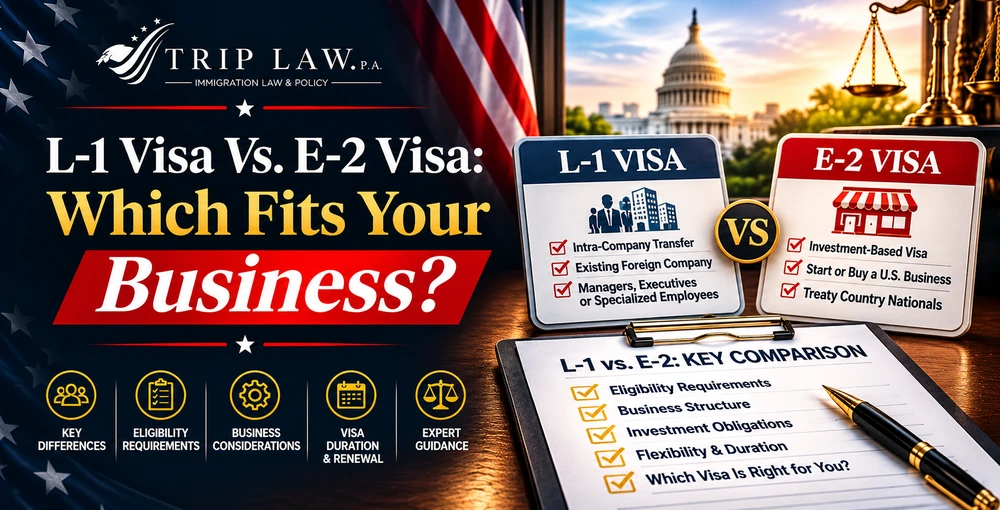
Compare L-1 intra-company transfer visas and E-2 treaty investor visas, covering eligibility requirements, investment obligations, business structure, and duration.
Your choice of an L-1 Intracompany Transferee Visa or an E-2 Treaty Investor Visa is entirely based on your nationality, how you currently have your business structured and whether you plan to pursue U.S. permanent residency in the future. Both visas allow foreign entrepreneurs and executives to grow or set up operations in the United States, but they cater to very different types of business arrangements. L-1 visas are a structural play to move people already in place within a multinational corporate structure, while E-2 visas are an investment play for individual entrepreneurs and investors from particular treaty countries.
Key Takeaways
- ▪L-1 requires a qualifying foreign business relationship.
- ▪E-2 requires qualifying treaty-country nationality.
- ▪L-1 requires qualifying employment abroad.
- ▪Investors must commit significant capital for E-2 status. Investors must direct their U.S. business operations.
- ▪The L-1A visa covers corporate executives. L-1A visas suit business managers.
- ▪L-1B visas suit specialized personnel.
- ▪E-2 visas demand enterprise leadership.
- ▪Both options grant temporary stay.
What Is The Main Difference Between L-1 And E-2?
Qualification rules separate these options. L-1 transfers foreign employees to related U.S. offices. Treaty citizens run U.S. businesses. E-2 requires heavy investment.
Business owners must consider these differences. Foreign company owners often choose L-1. New U.S. investors often prefer E-2. Neither visa fits every founder automatically. Evaluate your corporate setup first. Analyze your personal circumstances thoroughly.
How Does The L-1 Visa Work?
The L-1 visa enables internal employee transfers. Qualifying companies move selected staff to U.S. branches. U.S. roles require managerial duties. U.S. roles require executive duties. U.S. roles require specialized knowledge.
This classification includes two main types. L-1A status covers corporate managers. L-1A status covers company executives. L-1B covers qualifying employees with specialized knowledge. Generally, the employee must have worked abroad for one continuous year. That employment must occur within the relevant three-year period. The foreign and U.S. both entities need a qualifying relationship.
How Does The E-2 Visa Work?
The E-2 visa helps eligible investors. Applicants must hold treaty country citizenship. The U.S. enterprise must also meet nationality requirements.
The investor must place substantial capital into the enterprise. The investment must be committed and commercially at risk. Uncommitted funds sitting in an account generally do not qualify as an investment. The enterprise must also be real and operating. It cannot exist only as a passive investment. The investor must develop and direct the business.
L-1 Visa Vs. E-2 Visa: A Side-By-Side Comparison
This table highlights main structural differences.
| Feature / Requirement | L-1 Visa (Intracompany Transferee) | E-2 Visa (Treaty Investor) |
|---|---|---|
| Primary Basis | Multinational corporate structure & transfer | Treaty country investment & ownership |
| Nationality Requirement | No treaty country requirement | Must be a national of a qualifying treaty country |
| Prior Foreign Employment | 1 continuous year abroad in past 3 years | No foreign employment requirement |
| Investment Requirement | No minimum investment amount required | Substantial capital commitment required |
| Business Ownership | Qualifying parent / branch / affiliate entity | At least 50% ownership / active operational control |
| Path to Permanent Residency | L-1A offers dual-intent EB-1C path | Nonimmigrant status (requires separate strategy) |
These categories therefore solve different immigration needs. Your business structure should guide the comparison.
Who Usually Considers An L-1 Visa?
The L-1 visa helps global business growth. You own an active foreign company. You build a new U.S. branch. You scale existing U.S. operations.
The L-1 structure can potentially support that expansion. You may transfer a qualifying manager, executive, or specialized knowledge employee. The foreign and U.S. businesses must meet the required relationship rules. This makes the foreign company particularly important. Your application must establish the relationship between the entities. The petition proves prior work history. It details future U.S. duties.
Need Help Navigating U.S. Visa & Corporate Strategy?
Trip Law clarifies complex business immigration concepts and presents your business professionally.
Who Usually Considers An E-2 Visa?
Treaty citizens make U.S. investments. This visa assists them. Investors launch new commercial ventures. Investors buy existing American companies. This venture demands substantial capital. Investors direct daily operations. Owners maintain majority control. The business shows active economic activity.
Does L-1 Require A Specific Investment Amount?
The L-1 visa skips E-2 investment rules. It checks company organization structure. It verifies foreign employee history. It reviews proposed U.S. roles. New U.S. offices require extra conditions. The petitioner must show sufficient physical premises. It must also demonstrate that the U.S. operation can support the qualifying position within one year. Therefore, an L-1 business expansion still needs financial planning. It bypasses the E-2 investment test.
How Does E-2 Investment Differ From L-1 Expansion?
E-2 status requires large capital investments. The funds must be committed to the business. The enterprise must also operate commercially.
L-1 does not require the same investor test. Instead, the company must demonstrate a qualifying international corporate structure. The employee must also satisfy the relevant L-1 requirements. This difference can significantly affect business planning. An investor without an existing foreign company may examine E-2. An established international company may examine L-1.
What Are The L-1 Employment Requirements?
L-1 candidates meet strict work criteria. Generally, the beneficiary must have worked abroad for one continuous year. That employment must have occurred within three years before the relevant application or admission.
The foreign position must also qualify. L-1A demands managerial employment. The U.S. role satisfies strict criteria. Formal job titles miss duty proof. USCIS evaluates actual daily tasks. Officers inspect supporting documentation.
What Are The E-2 Business Requirements?
E-2 status demands active business operations. The investment must be substantial and sufficient for successful operation. The enterprise must also meet the applicable nationality rules.
The business cannot simply hold passive assets. It must conduct genuine commercial activity. The investor guides business growth. The investor controls company operations. An E-2 business plan can explain these elements. It should connect investment spending with operations and growth. The petition details executive responsibilities. It outlines daily leadership tasks.
Can You Use L-1 To Open A New U.S. Office?
L-1 rules allow new U.S. branch setups. New offices demand extra supporting documents. USCIS guidelines require physical lease proof. The petition confirms previous foreign management experience. It defines the intended executive duties. The company must sustain this role within twelve months.
This requirement highlights business plan importance. Your document describes U.S. business activities. It shows company management structure. It sets clear financial goals. It outlines future hiring strategies.
Can You Start A U.S. Business Through E-2?
The E-2 visa supports new U.S. business creation. Investors must commit significant financial capital. The enterprise must conduct active commercial operations. Your business model covers technology. It includes service sectors. It covers retail sales. It includes manufacturing operations. The business meets standard visa guidelines.
Your business plan details daily operations. It identifies target customer groups. It projects anticipated company revenues. It tracks expected operational expenses. It plans employee hiring schedules. It outlines future expansion targets.
Which Visa Has A Foreign Employment Requirement?
L-1 has a foreign employment requirement. Generally, the beneficiary must have one continuous year of qualifying employment abroad. That employment must fall within the relevant three-year period.
The E-2 visa skips foreign employment checks. It prioritizes investor treaty citizenship. It evaluates capital investment amounts. It verifies active business operations. It inspects the owner's managerial role. This difference guides entrepreneur choices. Founders with foreign management history consider L-1 visas. Inexperienced foreign investors explore E-2 options.
Which Visa Depends On Treaty-Country Nationality?
E-2 depends directly on treaty-country nationality. The principal investor must generally be a national of a qualifying treaty country. The U.S. enterprise must also satisfy the nationality requirement. L-1 does not use this E-2 treaty-country requirement. It evaluates company organizational links. It checks employee relationships.
What About Permanent Residence?
Neither visa offers permanent residency status. Both options provide temporary stay permissions. Future green card paths differ. L-1A can be relevant to certain employment-based immigrant strategies. L-1A holders need separate qualifications for green cards. Specific rules govern immigrant categories. E-2 visas exclude direct permanent residency.
Which Documents Matter For L-1?
L-1 petitions require valid corporate relationship documents. Applicants present past foreign employment records. Petitions include detailed U.S. duty descriptions.
Submissions feature official corporate files. Filings include company payroll records. Applicants provide business financial statements. Petitions contain detailed business plans. Specific evidence varies by petition. USCIS evaluates new office organizational structures. Officers examine business financial targets. Evidence should therefore explain how the U.S. business will develop.
Which Documents Matter For E-2?
E-2 applications focus heavily on investment evidence. Document your invested funds clearly. Applicants must prove committed capital. Business documents include equipment purchase records. Submissions contain commercial property leases. Filings show signed vendor contracts. Files feature official bank statements. The State Department notes that additional documents may be requested because circumstances vary. Your business plan should connect these documents. Every important financial figure should have a reasonable explanation.
L-1 Vs. E-2: Which Business Structure Fits Each?
Your business structure can provide a useful starting point.
| Business Scenario / Structure | Recommended Visa Analysis |
|---|---|
| Existing Foreign Company expanding to U.S. via manager/executive transfer | L-1 Intracompany Transferee Visa |
| Individual Investor from a Treaty Country launching a new U.S. business | E-2 Treaty Investor Visa |
| Foreign Business Owner without an existing corporate network seeking U.S. venture | E-2 Treaty Investor Visa (subject to treaty citizenship) |
| Multinational Corporation setting up a new branch or subsidiary in the U.S. | L-1 New Office Visa |
This table provides initial guidance. It avoids official eligibility decisions. Personal factors alter visa evaluations.
What Should You Consider Before Choosing?
Examine your current business. You evaluate your foreign company. Corporate relationships support L-1 structures. Check your nationality. Check your investment plans. Treaty nationals consider E-2 options. You test your investment against E-2 standards. Review your management duties. L-1 status targets internal transfers. E-2 status targets business leaders.
What Are The Main Questions To Ask?
Your answers can help organize your initial research.
- •Do you already own or work for a foreign company? This question can point toward an L-1 analysis. The foreign company's relationship with the U.S. entity will matter.
- •Have you worked abroad for the required period? L-1 requires one foreign work year. Job duties matter.
- •Check your treaty country status. E-2 status demands qualifying citizenship. Applicants check official lists.
- •Prepare substantial capital. E-2 requires significant financial commitments. Business type dictates required funding.
- •Will you manage the U.S. enterprise? E-2 investors manage company operations. L-1 positions must meet their own qualifying employment requirements.
Match The Visa To Your Business Structure
L-1 visa rules address distinct commercial scenarios. Companies transfer internal employees globally. Foreign business owners study L-1 rules. Overseas work history determines eligibility. Parent corporate links influence case approval. Prospective U.S. job tasks shape outcomes. New investors analyze E-2 criteria using valid treaty passports.
Proper visa selection reflects actual personal facts. Applicants evaluate current equity ownership. Individuals check past employment duration. Candidates calculate total committed capital. Owners match personal goals with legal requirements.
Conclusion
Trip Law clarifies complex business ideas. We transform detailed information into structured content. We highlight your services, strategy, and value clearly.
We present your business professionally across websites, marketing channels. We produce clear messages. We convert complex topics into helpful resources. Contact us today. We support your business communication goals.
Ready to Scale Your Business in the United States?
Let Trip Law present your brand and business messaging effectively across all platforms.
FAQs
Is L-1 Better Than E-2 For Business Owners?
Neither visa category holds absolute superiority. L-1 targets multinational company ties. E-2 emphasizes treaty citizenship plus capital investments. Your business structure should determine which requirements deserve closer review.
Can I Choose E-2 Without Owning A Foreign Company?
Yes, E-2 skips L-1 corporate connection rules. However, you must satisfy the E-2 requirements. Rules require treaty nationality, substantial investment, enterprise operations.
Can I Apply For L-1 Without Investing In America?
L-1 avoids E-2 heavy investment mandates. A qualifying international corporate tie must exist. The U.S. business demands valid organizational links. New office filings meet specific financial conditions. They satisfy distinct operational standards.
Does L-1 Require One Year Of Foreign Employment?
The beneficiary needs foreign employment. They complete one continuous year within three years. Foreign positions satisfy specific L-1 standards.
Can L-1 And E-2 Lead To A Green Card?
Neither visa grants permanent residency directly. L-1 status gives temporary permissions. E-2 status allows nonimmigrant entry. Applicants seek green cards through separate pathways.