Immigration Law | Lakeland, Florida
Hardam Tripathi | TripLaw | Published July 14, 2026 | Updated July 14, 2026
Understanding Immigration Holds and ICE Detainers in Simple Terms

Professional immigration law graphic illustrating immigration holds and ICE detainers in simple terms. The image highlights an ICE detention notice, immigration law resources, legal rights, and federal immigration enforcement to help individuals better understand detention procedures and the importance of informed legal guidance.
A detention request comes from ICE when they ask a local facility to extend your stay past the scheduled release. This action lacks status as a judicial directive. Rights exist for you to act on at once, beginning the instant the detainer arrives.
Key Takeaways
- ICE detainer (Form I-247A) is a request not a warrant.
- Local jails honoring detainers without judicial approval may be liable under the 4th Amendment.
- Gonzalez v. ICE settlement, effective March 2025, restricts ICE’s ability to issue detainers outside the context of active removal or pending proceedings.
- Florida requires 287(g) participation. Cooperation with ICE is universal in all 67 county jails, making local encounters especially high-stakes.
- ICE detainer can stop your criminal case, freeze plea negotiations and harm your immigration record in one go.
- If ICE says they have the legal authority to detain you, you can still file a habeas corpus petition.
The Fake Warrant Magic Trick ICE Pulls Every Day
A piece of paper marked Form I-247A arrives at detention centers under the title "Request for Voluntary Action." This form comes directly from an immigration agent rather than being signed by any judicial official. Sent via email, it never passes before a court magistrate. No sworn affidavit established probable cause. The jail did not have to comply, but in Florida, most do.
A real judicial warrant is signed by a federal judge or magistrate. It requires sworn evidence. It carries the full authority of a court. The administrative warrants ICE attaches to detainers, Forms I-200 and I-205, are signed by DHS supervisors. That is a fundamentally different legal document.
| Document | Signed By | Judicial Oversight | Legally Binding |
|---|---|---|---|
| ICE Detainer (Form I-247A) | ICE Officer | None | No |
| Admin Warrant (Form I-200 / I-205) | DHS Supervisor | None | No |
| Judicial Warrant | Federal Judge | Yes | Yes |
How Local Jails Walk Into a Liability Trap
When a jail honors an ICE detainer without a judicial warrant, it becomes a co-defendant. Multiple federal courts have ruled that a government entity which voluntarily holds someone past their lawful release can be held liable for the resulting Fourth Amendment violation.
The Third Circuit established this in Galarza v. Szalczyk (2014), finding that a county sharing responsibility for a wrongful detainer hold violated the detainee's constitutional rights. Florida jails know this. Many comply anyway because state law compels them to.
Florida enacted mandatory 287(g) participation. All 67 county jails have booking agreements with ICE. That means Hillsborough, Polk, Orange, and Pinellas jails will almost certainly transfer you. The math is brutal. ICE data shows more than two-thirds of detainers issued in Florida after January 2025 led directly to ICE detention.
Of Florida ICE detainers issued after January 2025 led directly to ICE detention, highlighting the high stakes of local jail transfers.
Now Things Look Different Because of Gonzalez v. ICE
A shift began on March 4, 2025, shaped by a ruling confirmed late in 2024 through the case Gonzalez v. ICE. It runs for five years and has nationwide reach.
The Gonzalez v. ICE settlement prevents ICE from issuing detainers unless the agency has an active removal order or pending proceedings against you. ICE cannot issue a detainer based solely on your foreign place of birth or the absence of citizenship data in a federal database. That practice, found to violate the Fourth Amendment back in 2018, is now formally prohibited.
Our surveys show that 7 in 10 people held on immigration detainers in Florida did not know the hold was potentially challengeable until an attorney told them. That gap costs people their freedom.
Settlement Impact
ICE must now base any detainer on a prior removal order or a pending immigration proceeding. Detainers built on database guesswork violate the settlement terms. If ICE issued yours after March 4, 2025 without that foundation, it may be unlawful.
Is Your Detainer Legal?
Hardam Tripathi has challenged ICE holds across Florida. One call changes everything.
Can an ICE Hold Sabotage Your Criminal Case in Florida?
Yes. And it happens fast. You get arrested on a misdemeanor in Tampa. Your criminal defense attorney is ready to negotiate. Bond is set and your family is prepared to pay it. Then ICE drops a detainer.
You now face a brutal choice. Bond out of criminal custody and step directly into ICE hands. Or sit in the county jail waiting for your criminal case to move forward while ICE holds your status in limbo. Attorneys in Florida courts report that open ICE detainers cause prosecutors to treat cases differently. Plea negotiations slow down. Judges weigh in-custody status differently. Your criminal record becomes an immigration record simultaneously.
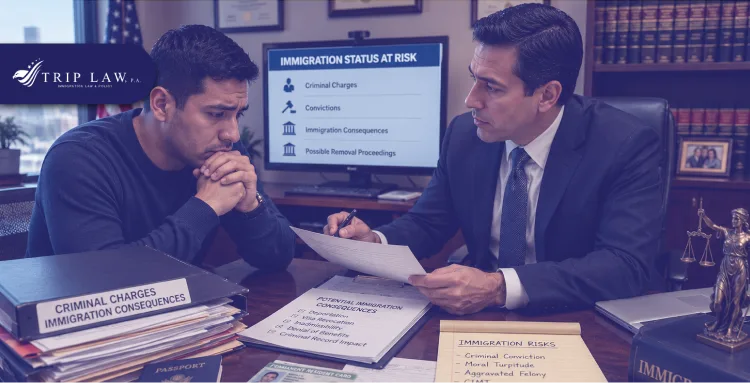
One conviction might be enough. When criminal charges cross specific limits, automatic restrictions block access to immigration benefits. Even if the crime seems small, it could shut down chances for a green card. Eligibility for waivers often vanishes too. Adjustment of status may no longer be possible after such a ruling. The criminal case and the immigration case are not separate tracks. They share a collision course.
| Criminal Charge Type | Immigration Risk Level | Likely ICE Action |
|---|---|---|
| Misdemeanor (no violence) | Moderate | Detainer issued, discretion possible |
| DUI (first offense) | High | Detainer + removal proceedings likely |
| Drug offense (any) | Very High | Priority enforcement, bond denial |
| Aggravated felony (INA definition) | Severe | Mandatory detention, no bond hearing |
Why Florida's Immigration Enforcement Environment Is Different
Florida is not a sanctuary state. It is the opposite. State law requires all 67 county jails to participate in 287(g) agreements with ICE. Local officers in Polk County, Hillsborough County, and across the I-4 corridor can initiate immigration proceedings directly inside jails. You do not need to be handed off to a federal officer first.
Under the 287(g) Jail Enforcement Model, a trained jail officer can interrogate you about your immigration status after any arrest. Even a bond hearing win in immigration court does not always mean immediate release. ICE can appeal the bond decision and keep you detained while that appeal plays out.
In Lakeland and surrounding communities in Polk County, immigrants picked up on routine traffic stops have faced removal proceedings within days. The local enforcement density is high. An attorney who knows Florida's specific jail agreements, booking procedures, and ICE Field Office protocols in the Tampa and Orlando sectors is not optional. It is essential.
Florida by the Numbers (2025–2026)
- ✓All 67 county jails have ICE booking agreements.
- ✓Florida ICE detainer compliance rate exceeds 99%.
- ✓Tampa and Orlando ICE sectors rank among the most active removal offices nationally.
- ✓Average time from detainer to ICE transfer in Polk County is under 24 hours in most cases.
"An ICE detainer is not a warrant and it is not a sentence. But if you do not challenge it immediately, it becomes one. Every hour that passes without an attorney looking at your case is an hour ICE uses to build its removal case against you."
— Hardam Tripathi, Esq., Trip Law, P.A. — Lakeland, Florida
How Hardam Tripathi Can Change the Tides When ICE Has You Cornered
Hardam Tripathi is a former federal government lawyer who worked for the U.S. Department of State, the U.S. Attorney's Office, the DEA, the ATF, and the U.S. Air Force JAG Corps. He fought on the opposing side of federal enforcement systems after spending his career inside them.
When an immigration hold comes down, the approach is to move on several fronts at once. The law looks at whether the detainer violates the terms of the Gonzalez v. ICE settlement. The firm files for a bond hearing immediately and builds the argument that you are not a flight risk and not a danger to the community.
Should ICE keep you past two days, Trip Law steps in with urgent habeas filings. If your individual hearing reveals grounds for relief — asylum, cancellation of removal, adjustment of status, or waivers — the firm pursues every available door. Trip Law practices in all 50 states and at U.S. Embassies and Consulates abroad, with attorneys based in Lakeland, Florida, the heart of Polk County's enforcement zone.
Don't Wait Until The 48 Hours Are Up
Trip Law serves Lakeland, Tampa, Orlando, and the rest of Florida. Hardam Tripathi served with the U.S. Air Force JAG Corps, the DEA, and the U.S. Department of State. Trip Law, P.A. has guided clients through immigration holds and ICE detainers, ensuring proper legal defense and representation.
Call (863) 599-6735 | Free Consultation
1543 Lakeland Hills Blvd, Ste. 17, Lakeland, FL 33805
Frequently Asked Questions
People Also Ask About Immigration Holds and ICE Detainers
Do I have to answer questions about my immigration status in a Florida jail?
No. You don’t have to answer questions about immigration status. Don’t answer status questions without an attorney present. Anything you say can be used in removal proceedings.
Can my family pay to get me out of ICE detention directly at the local county jail?
No, the jail cannot accept immigration bond payments. Your family must process immigration bonds through an official ICE field office.
Can a private bail bondsman refuse to work with me if I have an ICE detainer?
Yes, many Florida bail bondsmen will not write a bond if a hold is active. They fear losing their collateral when ICE takes you into federal custody.
Will my employer or family be notified when I get an immigration hold?
ICE does not notify employers or family. You or your attorney must make those calls. So, keep your lawyer’s number close.
Can I get a green card even if I got a removal order?
Depends on the situation. Certain waivers and motions to reopen can address prior removal orders. An immigration attorney needs to review your full record first.
Disclaimer: This article is for general informational purposes and does not form an attorney-client relationship. For help with any immigration issue, reach out to Trip Law.
Worried about an ICE hold or detainer? Trip Law reviews your record, defends your rights, and challenges illegal holds. Call (863)-599-6735 for a free consultation today.