Immigration Law | Travel Bans & Restrictions | United States
Hardam Tripathi | TripLaw | Updated 2026
How Travel Restrictions Affect Pending Immigration Applications
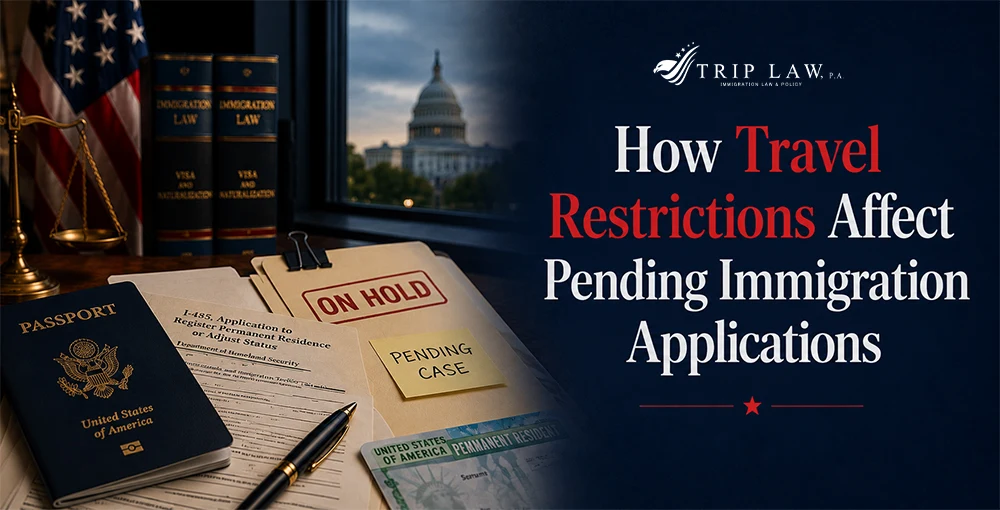
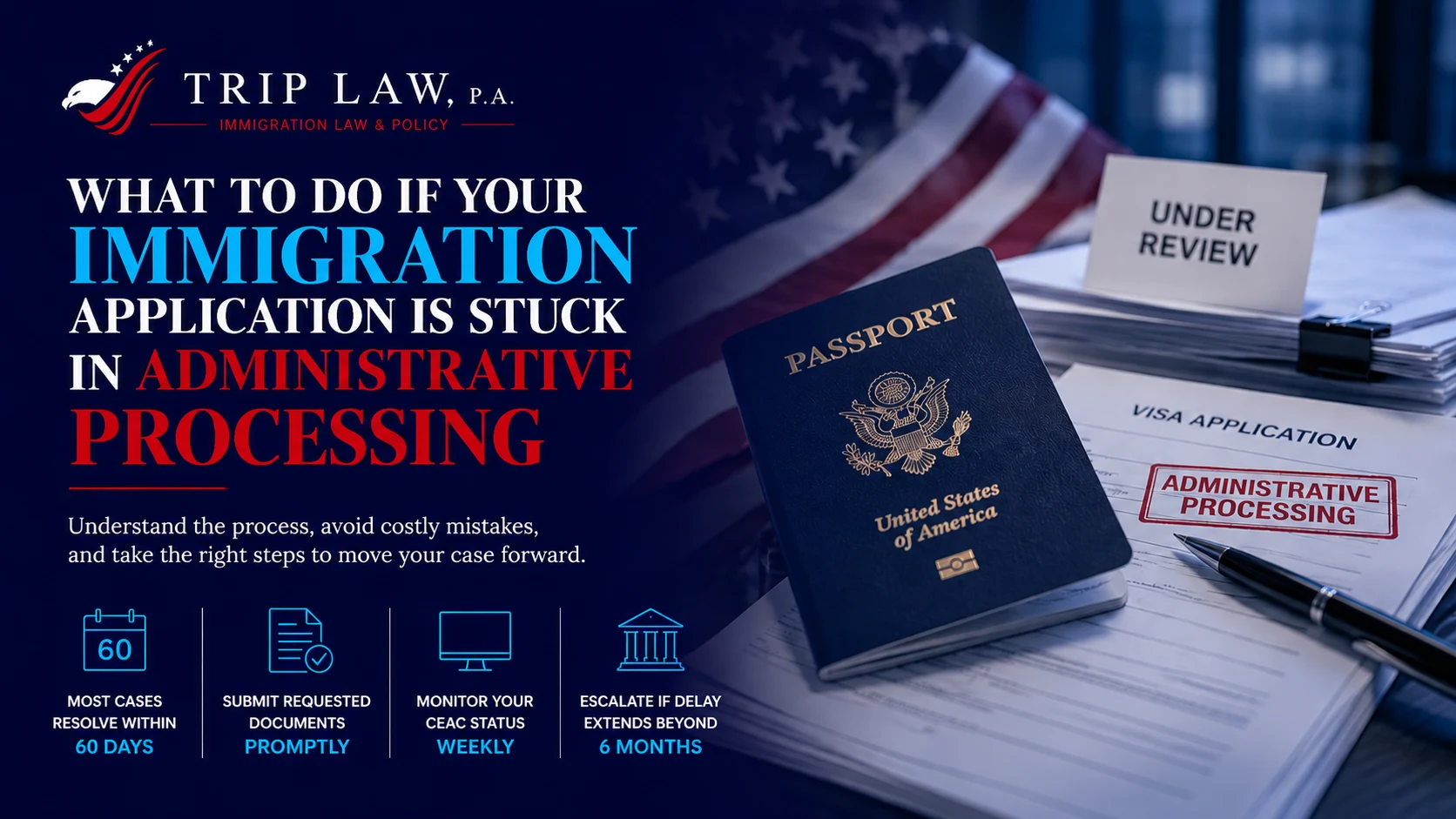
Informational immigration law graphic illustrating how travel restrictions can impact pending immigration applications, visa processing, adjustment of status cases, and permanent residency petitions. Highlights legal considerations for applicants navigating changing travel policies.
Since January 2026, travel restrictions have frozen visa applications. This stalled green card filings and put asylum cases on hold for people from 39 countries. If your country made that list, your pending application is exactly where you left it. Weeks pass. Nothing moves. And the worst part? That silence just feels like denial.
Key Takeaways
- Your Adjustment of Status (I-485) isn't paused by the consular freeze, but a separate USCIS memo does the same job.
- Leaving the U.S. while your application is pending can wipe out years of waiting in a single trip.
- B-1/B-2, F, M, and J visa holders from restricted countries face partial or full bans.
- Exceptions exist. But they don't find themselves. An immigration attorney has to go looking.
What Exactly Happens to Your Application When a Travel Ban Drops?
The file stops. That's it.
When a presidential proclamation names your country, USCIS stops working on your case. Your green card petition, your work permit, and your asylum claim. All of them just sit in a queue that's no longer moving. And look, "pause" sounds temporary and manageable. But nobody tells you when it ends.
USCIS keeps firing off Requests for Evidence and Notices of Intent to Deny even during the hold. You still have to respond to those. Every single one, on time. Miss a deadline because you thought the hold meant everything was frozen and USCIS would close your case anyway. The pause isn't an excuse they accept.
And then there's this. On January 1st, 2026, USCIS ordered a re-review of every benefit they approved on or after January 20, 2021, for nationals of those 39 restricted countries. Approvals that have already gone through. Cases that people thought were done and settled. Those are being pulled back.
If you got an approval in that window, you need someone looking at your file. Not eventually. Now.
January 2026 USCIS Action
39
Countries under an indefinite benefit hold, including re-review of approvals dating back to January 20, 2021
Does Leaving the United States Put Your Pending Application at Risk?
Short answer? Yes, and it's one of the most painful mistakes Florida applicants make.
Here's how it goes wrong. Your I-485 is pending. You've been waiting for a long time, maybe years. A family situation comes up back home. You book a flight without checking with an attorney first because you figure your case is already filed and sitting, so what's the harm?
The harm is that USCIS marks your application as abandoned the moment you leave without Advance Parole. That's the technical term. Abandoned. As in, gone. No refund. No restart. No appeal based on the circumstances. You're back at square one with nothing to show for the wait.
And even if you do have Advance Parole in hand, coming back isn't guaranteed. Customs and Border Protection officers have wide discretionary authority to turn people away. Travelers from restricted countries are getting flagged for longer secondary inspections right now across every major Florida port of entry. Our survey of clients navigating travel complications through 2025 and into 2026 found that more than 60% of those who traveled without legal guidance hit unexpected problems on their return.
Trip Law works with clients on travel decisions before any international flight gets booked, especially now. The rule couldn't be simpler. Talk to an immigration attorney before you buy the ticket. Not when you land. Before you leave.
"International travel during a pending adjustment of status case is one of the most consequential decisions an applicant can make. One wrong move can erase years of waiting."
— Hardam Tripathi, Attorney, Trip Law, P.A.
Which Visa Types Are Taking the Hardest Hit from the 2026 Travel Restrictions?
Not everyone's in the same boat here. The 2026 travel restrictions carved out three pretty distinct tiers of impact, and which tier you land in changes everything about how you should respond. NAFSA's breakdown of the proclamation confirms these tiers are still in full effect through at least mid-2026. Take a look.
| Visa / Benefit Type | Impact Level | Severity |
|---|---|---|
| Immigrant Visa (Abroad) | Full Pause | Critical |
| Asylum (I-589) | Full Pause | Critical |
| Green Card (I-485 in U.S.) | Paused by USCIS Memo | High |
| EAD / Work Permit | Paused by USCIS Memo | High |
| H-1B (Restricted Country) | Increased Scrutiny | Elevated |
| B-1/B-2 Tourist Visa | Partial Ban | High |
| F / M / J Student Visa | Partial Ban | High |
| Lawful Permanent Residents | Mostly Exempt | Lower |
If you're sitting in Tampa on an F-1 student visa, this is not background noise you can tune out. If your employer is sponsoring an H-1B worker from a restricted country, the same goes for you. These categories aren't immune. They're just impacted differently, and understanding that difference is what allows you to build an actual strategy instead of just waiting. Trip Law handles employment and student visa cases across all of Florida and in all 50 states.
Is Your Immigration Case Caught in the 2026 Travel Ban?
Attorney Hardam Tripathi reviews your specific situation. Don't wait for a denial letter to show up first.
Can You Still File for Asylum If You're from a Restricted Country?
This question is coming up constantly right now from immigrant communities across Florida, and the honest answer has some texture to it.
The December 2025 USCIS memo puts an indefinite hold on I-589 asylum applications filed by nationals from all 39 designated countries. But the rules do carve out some narrow exceptions. Lawful permanent residents and dual nationals traveling on a non-restricted passport may still have a path. Whether you actually fit that exception depends on your specific facts. General rules won't tell you that. Only a careful review of your individual case will.
This is what I really can't wait for, though.
Asylum has a one-year filing deadline. It runs from the date you first arrived in the United States. A travel ban does not pause that clock. It just doesn't. If you've been putting off filing because things felt uncertain or complicated, that deadline is moving, whether your case is frozen or not. An attorney might still be able to argue extraordinary circumstances if the window has already closed, but that argument gets harder the longer you wait.
WITHOUT Legal Guidance
- Application frozen, no updates for months
- RFE deadlines missed, case dismissed
- Travel outside U.S. abandons your I-485
- No idea which exceptions might apply to you
WITH Trip Law on Your Side
- Case reviewed for travel ban exceptions
- Every RFE response handled on time
- Advance Parole plan in place before travel
- Clear roadmap from day one
How Do Travel Restrictions Affect a Green Card Application Filed Right Here in the U.S.?
Adjustment of Status, which is the I-485 process for people who are already inside the U.S., isn't technically paused by the immigrant visa freeze happening at overseas consulates. So if you filed from within the country, the consular freeze alone doesn't touch you. But then the separate December 2025 USCIS policy memo kicks in. That memo puts its own hold on I-485 adjudication for nationals of restricted countries. Different mechanism, same result. Your file still isn't moving.
Our survey of immigration clients across Florida found that close to one in three applicants from affected countries had no idea their I-485 was caught by the USCIS memo, not just the consular freeze. That gap matters because certain derivative beneficiaries and priority date holders still have angles worth pursuing, but you have to know to look for them first.
GREEN CARD NUMBERS: THE DROP IS REAL
Max Scale: 700,000 Visas
If you filed your green card application in Tampa, St. Pete, Miami, or anywhere else in Florida before the ban landed, your petition is still in line. The goal right now is keeping it there, in good standing, while someone maps out what's still open to you. Trip Law builds that strategy around your country of origin and your specific visa category. Not a generic checklist. An actual plan.
"Policy bans don't erase your rights. They create obstacles, but every obstacle has a legal angle that a skilled immigration attorney can explore. Giving up is the only guaranteed loss."
— Stephen Yale-Loehr, Professor of Immigration Law Practice, Cornell Law School
What Do You Actually Do Right Now to Keep Your Case from Falling Apart?
Waiting is not a plan. Not in 2026.
The people who come through this period with their applications still intact are the ones making moves now, not the ones hoping things sort themselves out by summer. USCIS and the U.S. State Department are updating policies constantly. You need someone actively tracking those changes on your behalf, because you can't do that while also living your life.
Five steps. Do all of them.
Find out exactly what your country's status is.
Full ban. Partial ban. Benefit hold. These aren't the same thing. Trip Law tracks the list in real time and can tell you precisely what applies to your case.
Don't book a flight without Advance Parole in hand.
If your I-485 is pending, leaving the country without that document abandons your application automatically. No exceptions, no appeals based on family emergencies. The rule doesn't bend.
Answer every USCIS notice on time.
The benefit pause doesn't buy you a pass on RFE responses or Notices of Intent to Deny. USCIS keeps issuing those regardless. A missed deadline closes your case whether it's frozen or not.
Get prior approvals reviewed.
Any benefit USCIS approved for you after January 20, 2021 may be under active re-review right now. If that window covers your case, you need eyes on your file before something unexpected happens.
Build your paper trail.
For adjustment of status cases, documentation of your ties to Florida, your employer, your family, your community, carries real weight when adjudication resumes. Start collecting it now, not later.
Your Application Doesn't Have to Stall Forever
Attorney Hardam Tripathi served with the U.S. Air Force JAG Corps, the DEA, and the U.S. Department of State. Trip Law, P.A. has guided clients through federal travel bans, green card freezes, and major policy changes in all 50 states and at U.S. Consulates abroad. That's the experience your case needs.
Call (863) 599-6735 | Free Consultation
1543 Lakeland Hills Blvd, Ste. 17, Lakeland, FL 33805
Frequently Asked Questions
People Also Ask About Travel Restrictions and Immigration Status
Can a travel ban cancel an already-approved green card?
Not directly. But USCIS is actively re-reviewing approvals granted after January 20, 2021 for restricted-country nationals. Get your file reviewed now, before something moves without you knowing.
Does the 2026 travel ban affect U.S. citizens petitioning for family abroad?
Yes. If your petitioned relative is a national of a restricted country, their immigrant visa appointment at any U.S. Consulate abroad is paused with no set end date.
What happens to my EAD if my green card is stuck on hold?
USCIS paused EAD adjudications alongside the I-485 hold. If your work permit is expiring soon, file a renewal immediately. Gaps in work authorization have real consequences.
Are any nationalities exempt from the USCIS benefit pause?
Lawful permanent residents and dual nationals holding a passport from a non-restricted country may qualify for exceptions. Don't assume you qualify without a legal review of your specific situation.
How long is this travel ban actually going to last?
No official end date exists. The January 2026 proclamation has no automatic sunset clause. It stays in force until a new presidential action or a court order changes it.
Disclaimer: This article is for general informational purposes and does not form an attorney-client relationship. For help with any immigration issue, reach out to Trip Law.