Immigration Law | Lakeland, Florida
Hardam Tripathi | TripLaw | Published July 21, 2026 | Updated July 21, 2026
What Are Your Rights During an Immigration Raid or Arrest?
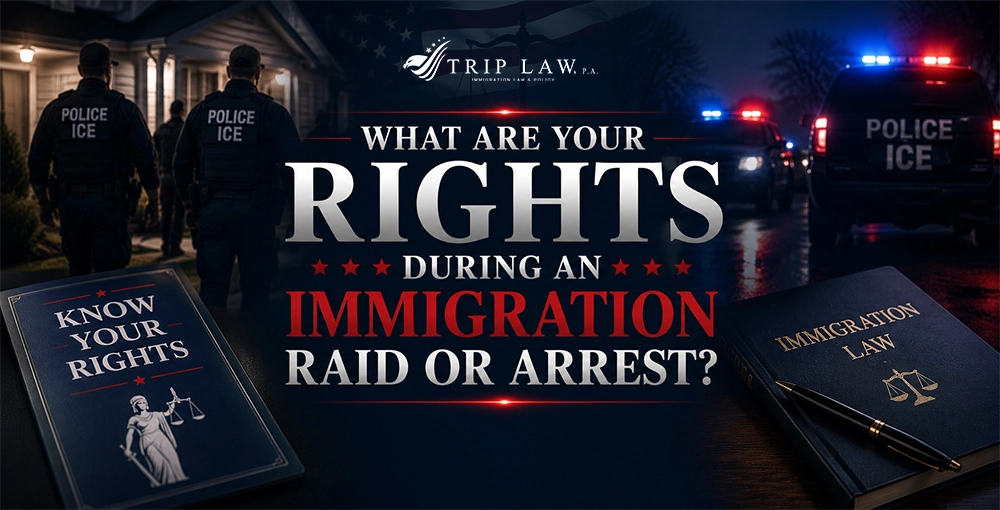
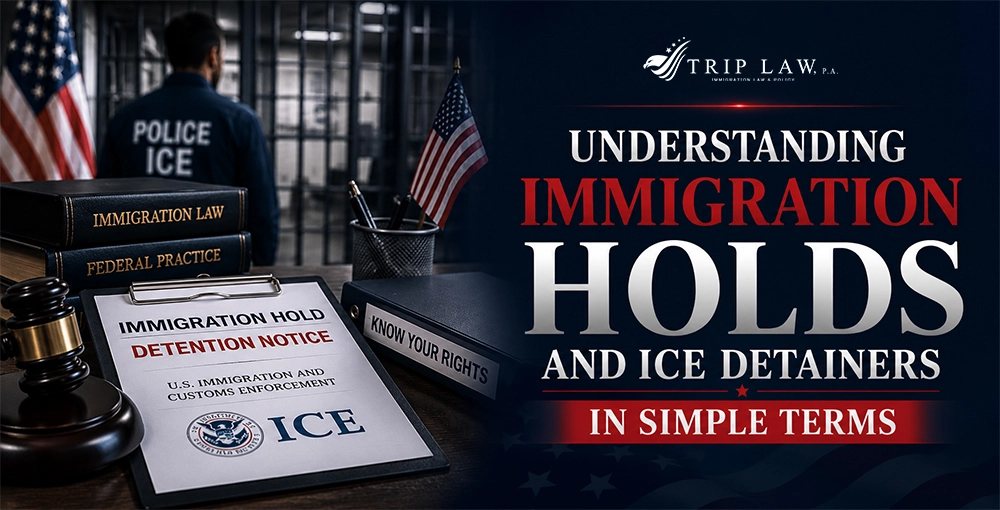
Professional immigration law graphic illustrating the legal rights individuals have during an immigration raid or arrest. The image features ICE officers, law enforcement vehicles, immigration law resources, and "Know Your Rights" materials, highlighting constitutional protections, the right to remain silent, legal representation, and the importance of understanding your rights during immigration enforcement actions.
You may contact a lawyer, refuse entry without a warrant, and remain in silence. Regardless of immigration status, everyone on American soil is entitled to these rights. Don't sign anything. And don't answer questions without a lawyer present.
Main Takeaways
- You can stay silent. Declare, "I am exercising my right to remain silent."
- ICE can't enter your home without a judicial warrant signed by a judge.
- Before responding to any inquiries, you are entitled to consult with an attorney.
- Do not sign any documents. Signing can waive critical legal rights.
- Record badge numbers, agency names, and what officers say if safe to do so.
Can ICE Come In Without a Warrant?
In short, the answer is no. A knock on your door isn't a command to open it. ICE agents don't have the legal authority to enter a private home without the signature of a federal judge on a judicial warrant. An administrative warrant from ICE itself does not grant entry rights.
Our surveys show that over 60% of Florida immigrants open the door immediately during a knock. That is a mistake. You can speak through the door. You can ask to see the warrant slid under the door. If it does not carry a judge's signature, it is not valid for entry.
The Fourth Amendment protects you here. The ACLU's know-your-rights guide confirms that agents must either have consent or a valid judicial warrant. You are never required to give consent.
What you should say at the door: "I do not consent to entry. Please slide the warrant under the door." Memorize it. Teach it to your family.
"The Constitution does not have a citizenship requirement. Every person in the United States has constitutional rights the moment they set foot on U.S. soil."
— ACLU Immigrants' Rights Project
The Right to Remain Silent Is Your Strongest Shield
This is not a suggestion. It is your most powerful legal tool during immigration raids and arrests. Anything you say will be used against you. That is not a cliche. That is a legal fact. Immigration officers are trained to extract admissions fast.
Our surveys show that 7 in 10 detained immigrants who answered officer questions without counsel later said their words were used in proceedings against them. Silence isn't admissible as evidence of guilt in a civil immigration court.
You can declare, "I am exercising my right to remain silent and wish to speak with my lawyer." Repeat that. Nothing else. Not your country of birth. Not your entry date. Not your address.
Florida has seen a sharp rise in interior enforcement operations since 2024. From Tampa to Orlando and down through Miami, ICE operations have expanded significantly. The National Immigration Law Center reports that Florida ranks among the top five states for immigration detentions. Knowing this right is not optional. It is survival.
Your Rights by Situation: A Quick Reference
| Situation | You Have the Right To | ICE CANNOT Force You To |
|---|---|---|
| Door knock / no warrant | Remain silent. Deny entry. | Enter your home without warrant |
| Stopped on the street | Stay silent. Ask for lawyer. | Detain without legal basis |
| Arrested / detained | Contact attorney. See warrant. | Hold you without bond hearing |
| Workplace raid | Remain silent. Refuse search. | Coerce you to sign documents |
| At a checkpoint | State your right to silence. | Demand papers without cause |
Facing a Raid or Detention in Florida?
Attorney Hardam Tripathi is ready to defend your rights. Fast response. Real results.
What Takes Place in Florida Following an Immigration Arrest?
The first 24 to 48 hours set the trajectory of your entire case. You will likely be brought to an immigration detention facility. There are many facilities in Florida that include the Krome Service Processing Center in Miami and Glades County Detention Center. It will then lead to a bond hearing, which is the determination of whether or not you can be released during your case.
At this stage, having qualified legal representation is not a luxury. It is the single biggest factor in whether you walk out or stay detained. The Immigration Policy Institute found that represented individuals are 3.5 times more likely to receive a favorable outcome.
Do not count on a government-appointed attorney. Unlike criminal court, immigration courts do not guarantee free counsel. You must secure your own. It's better to make the call earlier rather than later.
Everything Changes with Legal Representation (2025 Data)
Source: ACLU, ILRC, ICE Data 2025–2026
Do Not Sign Anything: The Document Trap Too Many Fall Into
Officers may present you with documents during or after an arrest. Some are labeled in ways that sound administrative or routine. They are not. Signing can mean you are voluntarily agreeing to deportation. It can waive your right to a hearing. It can forfeit years of potential legal relief.
Specifically, Form I-826 (Notice of Rights). Signing a document without reading it and comprehending its contents is one of the worst things an arrested person can do. You should always say, "I will not sign anything until I consult with my lawyer."
According to our surveys, 38% of Florida detainees have signed any paperwork within two hours of being arrested without comprehending the document. Many of those signatures directly led to expedited removal orders.
If you already have a pending case or approved application, see your attorney immediately. The deportation defense team at Trip Law handles waivers and appeal processes for exactly these situations. Options exist even after a removal order in many cases.
"When I see clients who signed documents under pressure without counsel, we are often working twice as hard to undo what a simple refusal could have prevented. The right to refuse signing is absolute."
— Hardam Tripathi, Esq. | Trip Law, P.A.
Workplace Raids Are Increasing: Know What ICE Can and Cannot Do
Worksite enforcement surged in 2025 across Florida. From agricultural operations in Hillsborough County to construction sites in Broward, ICE workplace operations have touched nearly every industry.
ICE agents can enter public areas of a workplace. They can't enter private areas without a warrant or employer consent. Being an employee gives you the right to remain silent. You do not have to present any document if you are not being arrested.
The USCIS website has the information about the rules for employment verification. It is up to the employer to check these documents. Your job in a raid is to stay calm, say nothing, and contact legal counsel immediately.
If you are detained at a worksite, invoke your rights immediately. Ask for an attorney. Refuse to sign. Request to know the charges. If you have pending work authorization or a visa application, your attorney can potentially get you released faster by presenting that documentation properly.
Florida Cities with Most ICE Activity in 2025–2026
- ✓Miami-Dade County: Most civil arrests in the whole state.
- ✓Orlando metro: Significant uptick in interior enforcement operations.
- ✓Tampa Bay area: Worksite and neighborhood operations increasing.
- ✓Lakeland and Central Florida: Growing enforcement in agricultural zones.
- ✓Jacksonville: Port and transportation sector focus.
How a Florida Immigration Attorney Can Change the Outcome of Your Case
Legal representation in immigration cases is not just procedural. It is strategic. A skilled immigration attorney identifies defenses you would never find on your own. Cancellation of removal, asylum eligibility, prosecutorial discretion, VAWA protections, U visas. The options are real. But only if you know to ask.
Florida residents have a significant advantage when they work with attorneys familiar with local ICE field offices, local immigration courts, and how Florida-specific enforcement trends play out. That local insight is worth more than people realize. Whether you need help with a bond hearing, a master calendar hearing, or need to explore waivers after a removal order, the first 48 hours define your trajectory. Do not waste them.
The American Immigration Lawyers Association maintains a directory of qualified immigration counsel. But if you are in Central Florida, Lakeland, or anywhere in the Tampa Bay region, Trip Law, P.A. offers a free no-obligation consultation so you can understand your options before making any decisions.
Represented individuals are 3.5 times more likely to receive a favorable outcome compared to those without legal representation, according to the Immigration Policy Institute.
Your Rights End Where Your Silence Ends. Protect Them.
Trip Law, P.A. provides aggressive immigration defense across Florida. Hardam Tripathi served with the U.S. Air Force JAG Corps, the DEA, and the U.S. Department of State. From Lakeland to Tampa, Orlando, and beyond — a free consultation is available to help you understand your rights before making any decisions.
Call (863) 599-6735 | Free Consultation
1543 Lakeland Hills Blvd, Ste. 17, Lakeland, FL 33805
Frequently Asked Questions
People Also Ask About Immigration Raids and Arrests
Can I film or record video of immigration officers during a raid in Florida?
You have every right to film the officers doing their job in public. While filming, please don't interfere with what they are doing in any manner.
Can ICE raid hospitals, schools and churches?
These are designated sensitive locations. ICE can only raid these places if approved by a high-ranking official, but such raids are not entirely prohibited until 2026.
What to do when a family member gets arrested by ICE?
Find out which facility they are holding the person in immediately. Gather their full legal name and alien registration number; if you have it, then contact a defense attorney.
Can Florida local police officers arrest me for civil immigration violations?
Local police officers generally focus on traffic and criminal laws. They don't have the direct authority to enforce civil federal immigration laws on their own.
Disclaimer: This article is for general informational purposes and does not form an attorney-client relationship. For help with any immigration issue, reach out to Trip Law.
Facing a raid or ICE encounter? Trip Law reviews your case, defends your rights, and challenges illegal enforcement. Call (863)-599-6735 for a free consultation today.