Employment-Based Immigration Law | PERM Labor Certification Guide
Hardam Tripathi | TripLaw | Published September 22, 2026 | Updated September 22, 2026
PERM Labor Certification Explained for Beginners
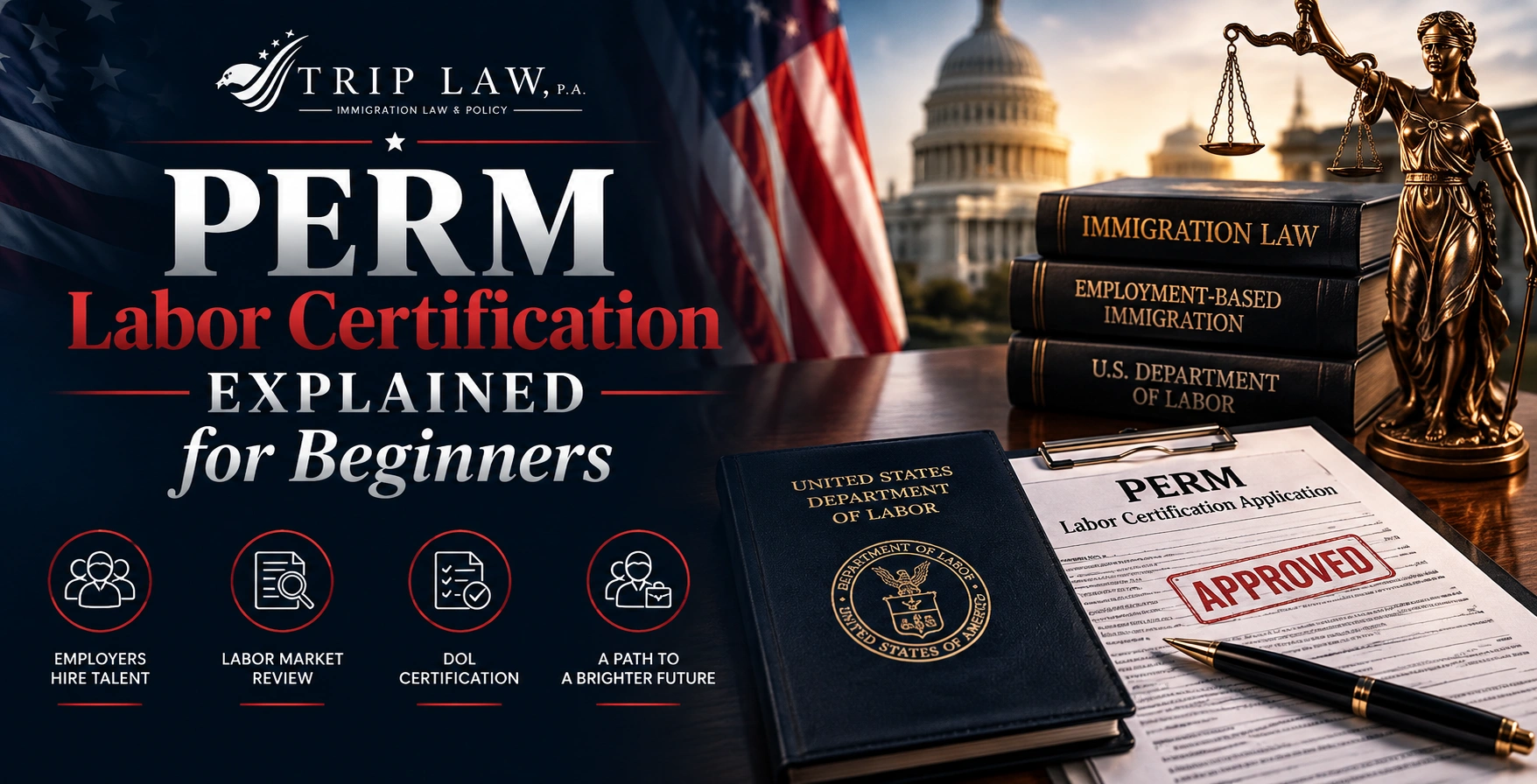
Learn how PERM labor certification works for beginners with Trip Law, P.A. Understand employment-based immigration, labor market review, and how to build a path to a brighter future.
The first step toward getting a Green Card (for EB-2 and EB-3 visas) is the PERM Labor Certification, which is a requirement for most employment-based Green Cards. It is administered by the U.S. Department of Labor (DOL) and its primary role is to protect the U.S. workforce. An employer must first convince the government that there are no qualified U.S. workers (citizens or Green Card holders) available to fill the position before they can sponsor a foreign worker.
Key Takeaways
- ▪PERM proves no qualified U.S. worker is available.
- ▪Your employer controls the process and cost.
- ▪Prevailing wage sets the minimum pay floor.
- ▪Recruitment must be real and documented.
- ▪Ads and ETA Form 9089 must match exactly.
- ▪Audits add months and require full proof.
- ▪PERM approval is not the green card.
What PERM Labor Certification Means In Simple Terms
PERM is a hiring test plus a filing. Your employer defines a role. The employer sets minimum requirements. The employer requests a government wage. The employer recruits domestic jobseekers. If the search produces no qualified applicants, the employer files ETA Form 9089.
PERM is handled by the employer. You support it. You do not file it alone. You do not pay required employer costs.
Who Needs PERM And Who Usually Does Not Need It
Most employment based green card cases in EB-2 and EB-3 need PERM. Many cases in EB-1 do not. Some special categories do not.
You should ask one direct question early: "Is my category PERM-based?" That answer controls your timeline.
Typical PERM Based Categories
These categories often use PERM:
- EB-2 for advanced degree roles.
- EB-3 for professional roles.
- EB-3 for skilled worker roles.
Common Categories That May Avoid PERM
These categories may avoid PERM:
- EB-1A extraordinary ability.
- EB-1B outstanding professor or researcher.
- EB-1C multinational manager.
Your facts control the final category.
The Fastest Way To Understand The Full PERM Timeline
PERM has three big phases. It starts with wages. It ends with certification or denial. It often takes many months.
Prevailing Wage Determination
Employers request a minimum pay floor from DOL tied to job level & location.
Mandatory Recruitment
Employers test the U.S. job market with strict, timed, mandatory advertisements.
Filing ETA 9089 & Waiting
Employer files online; DOL certifies, audits, or denies the application.
Phase One Is Prevailing Wage Determination
Your employer requests a wage from DOL. This is the minimum pay. It is tied to job level and location.
Your employer must pay at least this wage. This wage also shapes the job ad wording.
Phase Two Is Mandatory Recruitment And The Job Market Test
Your employer recruits for the role. Recruitment must follow strict rules. It must be timed right.
Recruitment tests the labor market. It does not test your performance.
Phase Three Is Filing ETA 9089 And Waiting For A Decision
Your employer files ETA Form 9089 online. DOL may certify it. The DOL may audit it. DOL may deny it.
If certified, you move to I-140. Then later, I-485 or consular processing.
What Employers Must Prove During PERM Recruitment
Your employer must prove a basic point. No able, willing, qualified U.S. worker applied. Or none was available for the role.
The employer must also prove good faith. The job must be real. Requirements must be normal. Ads must match the filing.
If DOL thinks requirements were tailored to you, risk rises.
What "Prevailing Wage" Really Controls For Your Case
Prevailing wage controls pay and compliance. It also controls how the role is described.
If the wage is high, budgets matter. If the wage is low, level matters. If the location changes, wage changes.
Prevailing Wage Levels You Will Hear About
DOL wages often map to levels. Many employers speak in four levels. Here is a practical comparison:
| Wage Level | Typical Role Fit | Risk If Mismatched | What You Should Check |
|---|---|---|---|
| Level 1 | Entry, supervised work | High, if duties look senior | Job duties match junior scope |
| Level 2 | Independent contributor | Medium, if duties look lead | Tools, scope, and autonomy |
| Level 3 | Senior, complex duties | Medium, if wage too low | Team impact and decision power |
| Level 4 | Lead, expert, or manager | High, if no leadership shown | Strategy duties and management |
Ask your employer for the wage level. Ask if duties match it.
What The Required Recruitment Steps Usually Include
Recruitment includes required ads. It can also include extra steps. The exact list depends on the role.
For many professional roles, employers must place:
- Two Sunday newspaper ads, or approved alternatives.
- A 30 day State Workforce Agency job order.
- An internal notice of filing at the worksite.
- Three additional recruitment steps, from an approved DOL list.
These steps must be documented according to official U.S. Department of Labor (DOL) PERM guidance. Dates matter. Copies matter.
How Employers Decide Job Requirements Without Triggering Red Flags
Job requirements must match the real role. They must fit the industry norm. They must not copy your resume.
Your employer should avoid rare tools such as "must have." Your employer should avoid too many "musts." Your employer should avoid combining roles.
If you change roles inside the company, caution rises. If you were trained on the job, caution rises.
What You Should And Should Not Do As The Sponsored Employee
You should support accuracy. You should not control recruitment.
You should confirm your work history facts. You should confirm degree details. You should confirm dates and titles.
You should not pay recruitment costs. You should not tell the employer who to reject. You should not suggest custom requirements.
Need Expert Guidance on Your PERM Application?
Navigating prevailing wages, recruitment, and ETA Form 9089 requires precision to avoid costly delays.
What Happens After PERM Is Approved
After certification, your employer usually files Form I-140 Immigrant Petition for Alien Workers with USCIS. This proves the company can pay the wage and that you qualify for the position.
Then you wait for your priority date. When current, you file Form I-485 or go through consular processing under employment-based green card pathways.
PERM approval does not give status. It is a step. It is not the green card.
What Happens If PERM Is Audited Or Denied
An audit means the DOL wants proof. It slows the case. It can be random. It can be triggered.
A denial ends that PERM filing. The employer may refile. The employer may appeal. Timing changes.
Common Audit Triggers You Should Know
These issues often trigger audits:
- Requirements seem tailored to you.
- Too many special skills listed.
- Unclear business need for requirements.
- Combination of multiple roles.
- Layoffs in related roles at the company.
- Foreign language requirement without strong need.
If any apply, plan for delay.
Beginner Level: The Minimum You Must Understand Before You Start
PERM is employer-led. Requirements must be normal. Recruitment must be real. Ads must match the filing. Your resume must match requirements.
If you are early in the process, ask these questions now: "What category?" "What requirements?" "What location?" "What wage level?" "What timeline?"
Intermediate Level: How To Reduce Delays And Mismatches
Delays often come from avoidable mismatches. Fix them early.
You should align five items before recruitment begins: Job title, duties, location, requirements, and wage level.
You should also keep a clean record. Save your pay stubs. Save offer letters. Save degree evaluations if needed.
A Simple Alignment Checklist That Prevents Many Problems
- ✓Job duties match wage level.
- ✓Requirements match industry norms.
- ✓Requirements match your pre-hire experience.
- ✓Location is accurate for the role.
- ✓Ads match the ETA 9089 language.
One mismatch can cause a big delay.
Expert Level: Strategy Topics That Matter In Complex Cases
Complex cases need strategy. Multi-location roles add risk. Remote work adds complexity. Promotions can add risk. Mergers add risk.
If you moved into the role after hire, you may need to prove you met requirements before joining. If experience was gained at the same employer, rules apply.
You should also watch the timing windows. Recruitment has strict validity periods. Late filing breaks the case.
When Remote Work Changes PERM Requirements
Remote work can change worksite rules. The location can affect wages. The posting location can change. The notice of filing must be correct.
Ask: "What is the primary worksite?" Ask: "Is the role hybrid?" Ask: "Will my address be listed?" These details matter.
Conclusion
PERM is a regulated hiring test. The employer defines job requirements. The company obtains the official wage. The employer conducts candidate recruitment. The company submits Form ETA 9089. The employer files Form I-140. The worker completes the final visa stage.
Trip Law assists your company. We simplify the complex PERM process. Our team builds well-documented immigration cases. Our service prevents costly delays. We eliminate application errors. We provide clear procedural guidance. Our experts guide your team. We manage the entire filing.
Ready To Make Your PERM Process Clear And Defensible?
Trip Law simplifies complex PERM workflows, prevents application errors, and ensures seamless compliance for employers and sponsored workers.
FAQs
What Are The Biggest Mistakes Employers Make In PERM Cases?
Discrepancies create problems. Job advertisements must match core responsibilities and candidate requirements. Minor wording differences trigger official audits. Employers should maintain identical role descriptions, ensuring wage requests match recruitment materials and Form ETA 9089.
Can I Pay For PERM Recruitment Or Attorney Fees?
Usually no. U.S. labor regulations require employers to pay all PERM costs, including mandatory recruitment ads and PERM legal fees. Sponsored employees may only pay for later-stage filings like the I-485 when eligible.
How Long Does PERM Labor Certification Take In Real Life?
Timelines vary depending on prevailing wage determination times, mandatory recruitment periods, and DOL processing workloads. Many standard cases take several months, while DOL audits can add additional months.
Does PERM Approval Give Me Work Authorization Or Status?
No. PERM approval is only a labor certification issued by the Department of Labor. It does not grant nonimmigrant status, lawful permanent residence, or employment authorization.
What If A U.S. Worker Applies During Recruitment?
Employers must evaluate U.S. job applicants honestly and objectively against the minimum job requirements. Qualified local applicants prevent the employer from proceeding with the PERM filing for that position.
Can My Job Requirements Include Specific Tools Or Languages?
Yes, but only if they are genuinely necessary for job performance. Rare software requirements or foreign language mandates increase audit risk and require the employer to document business necessity.
Disclaimer
This blog is for informational purposes only. If you want to know anything in details, please contact Trip Law.