Immigration Law | Waiver of Inadmissibility | Legal Guide
Hardam Tripathi | TripLaw | Updated 2026
Step-by-Step Guide to Filing a Waiver of Inadmissibility
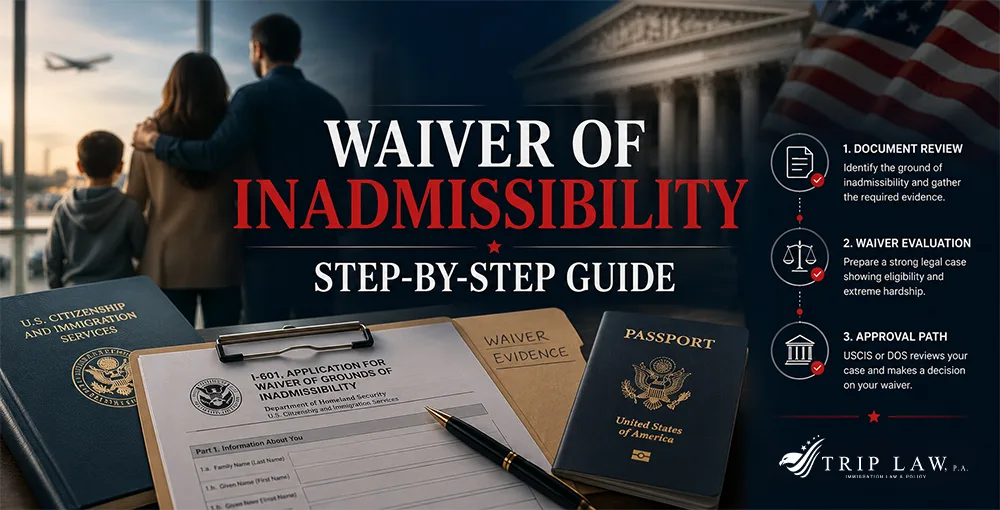
Informational immigration law graphic outlining the waiver of inadmissibility process. Covers document review, waiver evaluation, evidence preparation, hardship claims, and the approval process for applicants seeking admission or immigration benefits in the United States.
Filing a waiver of inadmissibility is a critical step in your U.S. immigration journey. First, you need to identify the exact waiver form to fill out. Then, you must collect extensive documentation proving that your qualifying family members will face extreme hardship if you are not allowed to enter or remain in the United States. This proof is vital for your family members trying to qualify. Finally, you compile all the papers and mail them to the USCIS or Department of State. Understanding the step-by-step process can greatly improve your chances of success.
Key Takeaways
- You must select the waiver form and the proper method of submission.
- You want to indicate that your family will endure a form of difficulty, not a general sad story.
- You need to have all your proof and a clear legal case.
- Be prepared for things like supplying fingerprints, being asked for information and waiting for a decision.
What "Inadmissibility" Means and Why It Blocks Your Case
“Inadmissibility” means U.S. law bars your admission or approval. It applies at U.S. consulates abroad and at USCIS offices domestically. It also applies at ports of entry.
Common triggers include unlawful presence, misrepresentation, certain crimes, health issues, and prior removals. Some grounds are permanent unless a waiver applies. Seeking professional advice early can help clear these blocks. Visit our immigration services page for more resources.
Comparison of Common Waivers and Their Coverage
Selecting the right form and pathway is critical. Below is a comprehensive look at the primary waiver paths, what they cover, and their standards.
| Waiver Path | Typical Use | Common Grounds | Where Filed | Key Standard |
|---|---|---|---|---|
| I-601 | Immigrant visa or AOS waiver | Misrep, some crimes, health, unlawful presence | USCIS (often after finding) | Often "extreme hardship" |
| I-601A | Provisional waiver before consular interview | Only unlawful presence | USCIS (inside U.S.) | Extreme hardship to qualifying relative |
| I-212 | Permission to reapply after removal | Prior removal, deportation, unlawful reentry bars | USCIS or CBP, case dependent | Discretionary, equities analysis |
| I-192 | Nonimmigrant entry when inadmissible | Many INA 212(a) grounds | CBP / USCIS route depends | Discretionary; risk and purpose |
Step 1: Get the Exact Inadmissibility Ground in Writing
You need the exact code section, the facts cited, and the finding source. Your "why" must match their "why." Do not guess.
What you should collect first includes refusal sheets, NTA (Notice to Appear) records, prior I-213s, and FOIA results. A Freedom of Information Act (FOIA) request can prevent unexpected surprises during your filing.
Step 2: Confirm That Your Ground Is Waivable
Some grounds have no waiver, some have limited waivers, and some require special forms. For example, unlawful presence and misrepresentation may be waivable, whereas certain drug violations often are not.
If the ground is not waivable, you may need a different strategy. That may include waiting out a bar, reopening the case, or seeking post-conviction relief. Do not file a waiver that the law does not allow; it wastes precious time.
Step 3: Identify Your "Qualifying Relative" Before You Draft Hardship
Most hardship waivers require a qualifying relative. That relative is defined by law and is not always your children.
Form I-601 and Form I-601A extreme hardship cases require qualifying relatives. These relatives include a United States citizen spouse, a United States citizen parent, a lawful permanent resident spouse, or a lawful permanent resident parent. The specific ground of inadmissibility determines the exact qualifying relative list. If you lack a qualifying relative, your case may fail. Confirm this early in the process.
Step 4: Choose the Right Waiver Route for Your Stage of Case
Your filing strategy changes based on where you are. If you are doing consular processing, you may face a refusal first, and then you file Form I-601. If you are inside the U.S. and only have unlawful presence, you may use Form I-601A first.
If you have a prior removal, you may need Form I-212 as well. Some cases require both I-601 and I-212. Ask yourself two direct questions: Where is your case pending right now? What exact ground was found?
Step 5: Learn the Standard You Must Prove and Write to It
Your waiver is not just a life story; it is a legal test. Some waivers require "extreme hardship," some require "rehabilitation," and others require "national interest" factors. Many are discretionary even after you meet the threshold eligibility.
If you must show extreme hardship, you must show more than normal pain or sadness. You must show specific, documented impacts and tie them directly to your qualifying relative.
USCIS explains extreme hardship factors in its Policy Manual. You can review the details on the USCIS Policy Manual Extreme Hardship Guidance.
Step 6: Build Your Evidence Around Themes USCIS and DOS Recognize
You should organize evidence into clear hardship buckets. You should also include strong positive equities. Hardship often fits these categories:
- Medical and mental health needs.
- Financial and employment harm.
- Education disruption.
- Country conditions and safety risks.
- Caregiving duties for children or elders.
- Special needs support and services access.
Positive equities often include steady work history, tax compliance, community ties, and rehabilitation proof. You should label each exhibit and cross-reference it directly in your legal brief.
Step 7: Use a Clean Document Package That an Officer Can Review Fast
Officers have limited time. Make your package skimmable. A strong package includes a cover letter, a legal brief, a table of contents, tabbed exhibits, and a short declaration.
Applicants must avoid long, unformatted paragraphs, eliminate overly emotional statements, use short sentences, and create clear headings that match the legal test.
Evidence Checklist You Can Adapt
- ✓ID documents and relationship proof
- ✓Refusal notice or inadmissibility finding
- ✓Qualifying relative proof of status
- ✓Medical records and clinician letters
- ✓Therapist evaluation, if relevant
- ✓Financial records and budgets
- ✓Country condition reports from reputable sources
- ✓Police and court dispositions, if crimes exist
- ✓Rehabilitation proof, if needed
- ✓Affidavits from credible witnesses
Use credible sources for country conditions. Examples include U.S. State Department Country Reports.
Applicants require professional assistance for legal matters. Legal cases involve complex aspects that experts should handle. People consider outside consultations to protect their future. Trip Law provides professional legal services to assist with your case.
⚠ Not Sure Which Waiver Applies to You?
Many waiver denials happen because applicants file the wrong form or miss a qualifying relative. Before you draft anything, confirm your exact inadmissibility ground and the correct path.
Step 8: Arrange the Required Forms, Fees, and Biometrics Steps
Each form has strict instructions. Always follow the newest version. You must sign in ink if required, include the correct fees, and provide certified translations for non-English documents.
Biometrics may be required, and some waivers trigger extensive background checks. Plan your timeline carefully. Always verify fee amounts and filing addresses directly on the USCIS Fee Calculator page. Do not rely on outdated blog posts.
Step 9: Write a Waiver Brief That Makes the Decision Easy
Your brief should answer the officer's questions immediately and support each point with solid evidence. A useful structure is simple:
Start with the ground of inadmissibility and the waiver authority. State the qualifying relative and the standard. Then, walk through each hardship factor with citations to your exhibits. If discretion is required, argue discretion directly by comparing positive factors versus negative factors. Show rehabilitation and low future risk.
Step 10: Track Your File and Prepare for a Request for Evidence (RFE)
Always track receipt notices after filing and keep copies of everything. RFEs are common; they are not a denial. They are a signal that something is unclear or missing.
Respond before the deadline and answer every point clearly. Do not add unrelated documents. If you are in consular processing, coordinate with the consulate's instructions after approval. Approval does not always mean immediate visa issuance.
Strategy Levels for Applicants
What to Do If You Are Confused Right Now
How to Improve Approval Chances With Better Hardship Framing
How to Handle Complex Cases With Multiple Grounds
Common Mistakes That Cause Delays or Denials
- ✕Filing I-601A when you have misrepresentation issues
- ✕Claiming hardship to children when not allowed
- ✕Submitting no certified court dispositions
- ✕Using generic hardship statements without documents
- ✕Ignoring discretion and negative factors
- ✕Failing to explain inconsistencies in prior filings
Timelines and Latest Trends in 2026
Processing times change often. Officers also scrutinize credibility more than before. Digital record sharing is broader, and consular notes can surface inconsistencies. You should expect more focus on clear timelines of events with dates, clean certified records, and professional evaluations when mental health is claimed.
Always check the USCIS Processing Times Tool for the latest estimates.
What Filers Find Hardest: Survey Results (n=63)
Trip Law Reader Survey · May 2026
Not a government dataset. Directional only. Matches real case patterns.
A Quick Self-Audit Before You File
- ✓What is the exact INA section cited?
- ✓Is the ground waivable in your category?
- ✓Which form matches your ground and stage?
- ✓Who is your qualifying relative by law?
- ✓What is the legal standard you must meet?
- ✓What are your top three hardship themes?
- ✓What are your top three positive equities?
- ✓What negative factors must you address?
Your Family's Future Depends on Getting This Right
Trip Law helps you identify the exact ground, choose the correct waiver path, and build evidence that fits the legal standard, avoiding costly RFEs and delays.
Protect Your Family's Future with Trip Law
Attorney Hardam Tripathi served with the U.S. Air Force JAG Corps, the DEA, and the U.S. Department of State. Trip Law, P.A. has guided clients through waiver of inadmissibility applications and complex immigration issues. Ensure your family's future is protected.
Call (863) 599-6735 | Free Consultation
1543 Lakeland Hills Blvd, Ste. 17, Lakeland, FL 33805
Frequently Asked Questions
People Also Ask About Waivers of Inadmissibility
Can you file a waiver before the consular interview?
Sometimes. Applicants normally file an I-601A provisional waiver first if their only ground is unlawful presence. Most other grounds require a consular finding first, followed by an I-601 filing.
Is "extreme hardship" required for every waiver?
No. Some waivers use different standards. Many still require proof of discretion. You must match the exact waiver authority to the ground of inadmissibility cited in your case.
Do hardships to children count for I-601A?
Children's hardship can support the overall context of the application. However, the qualifying relative for I-601A is strictly a U.S. citizen or LPR spouse or parent. Confirm your specific rules.
What evidence matters most in an extreme hardship waiver?
Medical records, clinician letters, financial proof, caregiving duties, and credible country reports. USCIS officers require documentation showing clear links to your qualifying relative's hardship.
How long does a waiver take in 2026?
Waiver processing times vary. The specific form, the local field office, and the consular post affect the speed. Check USCIS processing times and plan for delays. Build a strong case to avoid an RFE.
Disclaimer: This article is for general informational purposes and does not form an attorney-client relationship. For help with any immigration issue, reach out to Trip Law.