
Investor Immigration Law | E-2 Treaty Investor Visa | Denial Avoidance Guide
Hardam Tripathi | TripLaw | Published November 16, 2026 | Updated November 16, 2026
Common Reasons E-2 Visa Applications Are Denied
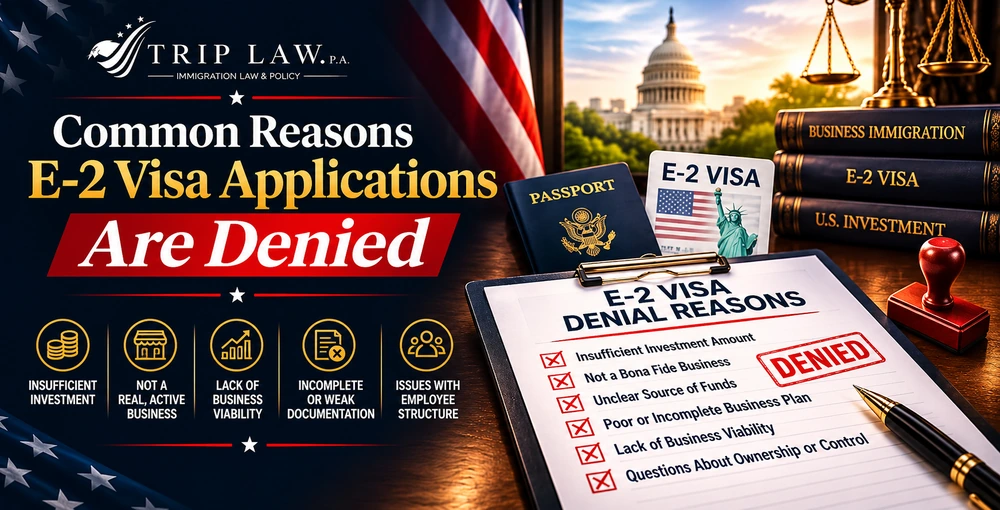
Learn the most common reasons E-2 investor visa applications get denied, including insufficient investment, unclear source of funds, and weak business plans.
Most E-2 visa denials are due to the applicant not meeting the stringent structural and financial requirements set by U.S. immigration law. While the overall approval rate is still fairly high, there is a lot of scrutiny around the viability of the business and the legality of the capital.
Key Takeaways
- ▪Your investment must be substantial and committed.
- ▪Your business must be real and commercially active.
- ▪Your business cannot rely only on family income.
- ▪You must develop and direct the enterprise.
- ▪Your treaty nationality must meet current requirements.
What Does An E-2 Visa Denial Mean?
Visa rejections indicate missed qualification standards. Specific legal reasons mirror your situation. Authorities deliver written notices explaining denial bases. Rejections never invalidate business concepts. Incomplete proof causes frequent denials.
1. The Investment Is Not Substantial Enough
An insufficient investment can create a serious E-2 problem. The government avoids set minimum capital requirements. Enterprise needs determine required investment levels. Spending must reflect corporate operational models.
Capital-heavy businesses require large startup cash. A service company may require less capital. The important issue is whether your investment is sufficient for your enterprise.
What Makes An E-2 Investment Substantial?
Invested funds prove real business dedication. Officers evaluate total setup costs against invested funds.
Consider these factors:
- •Total cost of establishing the business
- •Amount already invested
- •Amount committed to future expenses
- •Business type and operating requirements
- •Evidence supporting your investment
- •Expected financial needs during startup
No fixed sum guarantees visa success. Clear proof shows capital suitableness for your enterprise.
2. Too Much Money Remains Uncommitted
Simply placing money into a U.S. bank account does not establish an E-2 investment. The State Department specifically states that uncommitted or revocable funds generally do not qualify.
Investors must commit funds to the venture. Capital buys necessary equipment. Money covers starting inventory. Capital expenditures cover lease contracts. Investment funds purchase existing businesses. Financial records trace capital movement. Bank records track outgoing funds. Invoices confirm transaction details. Receipts prove actual spending. Contracts validate business agreements. Purchase documents establish financial links.
3. The Business Is Not A Real Operating Enterprise
The E-2 visa requires an active commercial enterprise. Paper entities fail qualification tests. Passive investments violate program rules. Applications must prove live business operations. Commercial leases demonstrate active operations. Purchased equipment shows business functionality. Stocked inventory proves commercial presence.
Hired staff confirms business activity. Signed contracts demonstrate operational viability. Active clients indicate real market presence. Valid licenses establish legal standing. Paid expenses show active operations. Business plans alone fail approval standards. Supporting records prove real business formation.
4. The Business Appears Marginal
Marginality is another important E-2 consideration. The enterprise must exceed basic personal living costs. The business must generate substantial domestic economic value. Financial forecasts demonstrate future business growth.
The plan details revenue expansion. Numerical figures outline projected payroll growth. Clear timelines specify future hiring plans. These figures should have realistic assumptions behind them.
Need Expert Help Structuring Your E-2 Application?
Ensure your investment proof, financial models, and business plan meet strict U.S. consular standards.
5. The Applicant Cannot Show How They Will Direct The Business
The main investor must guide company operations. Applications must detail your management duties. Business plans detail primary executive duties. Leaders handle hiring processes. Executives control corporate funds. Directors lead marketing plans.
Managers supervise daily operations. Prior experience proves leadership preparedness. Educational background demonstrates managerial competence.
6. The Applicant Does Not Have Qualifying Treaty Nationality
Treaty country citizens qualify for E-2 status. The American company must share treaty nation citizenship. At least 50% ownership must generally involve nationals of that treaty country.
Nationality should therefore be checked before preparing your application. A strong business plan cannot overcome a basic nationality problem.
The State Department updates treaty country lists. Applicants must verify official government rosters. Applicants must skip old visa guides.
7. The Source Of Investment Funds Is Not Clearly Documented
Submissions must explain capital sources. Officers track capital movements into enterprises. Documented financial trails verify fund sources. Bank statements prove asset transfers.
Income records show earnings origins. Sale documents verify property transactions. Loan contracts prove debt funds. Tax returns verify earnings. Individual circumstances determine required proof. The State Department notes that additional documentation may be requested because circumstances differ between cases.
8. The Business Plan Contains Unrealistic Financial Projections
Inflated projections damage application trust. Ambitious profit goals demand reasonable assumptions. Flawed financial templates destroy enterprise credibility.
Predictions must include market research data. Numbers must match pricing models. Financial plans fund marketing costs. Staff figures equal hiring targets. Investment levels must reflect total capacity.
A useful financial model should connect several areas:
| Business Area | What Your Plan Should Explain |
|---|---|
| Revenue | Customers, prices, and expected sales |
| Expenses | Operating and startup costs |
| Marketing | Customer acquisition strategy |
| Payroll | Staffing and salary expectations |
| Growth | Future sales and employment |
The numbers should tell one consistent story. Target revenue justifies labor requirements. Invested capital covers operational expenses.
9. The Business Plan Does Not Match The Evidence
Discrepancies trigger officer doubts. Your plan must match legal contracts. Figures must align with financial statements. Details must reflect official filings.
Plans state specific funding totals. Bank records show distinct figures. Financial mismatches demand explicit clarifications. Ownership details need consistent reporting. Your application must state business operations clearly.
10. The Applicant Cannot Explain The Business Clearly
Interviews demand clear company explanations. Vague replies block eligibility checks. Applicants must master operational facts.
Candidates must track exact funding figures. Founders must identify primary customers. Managers must clarify price points. Executives must monitor operating costs. Management must study market rivals. Directors must outline growth targets. Leaders must understand executive duties. Interview responses must mirror written application records.
11. The Applicant Cannot Establish A Temporary Intent
E-2 classifies temporary investor standing. Holders must plan departure following status expiration. Investors may pursue extended commercial targets.
You must satisfy standard E-2 rules. Your file must detail your specific immigration situation. Truthful claims maintain overall application consistency.
12. The Application Does Not Include Enough Supporting Documentation
Incomplete files block smooth application evaluations. Incomplete files hinder qualification assessments. Officials expect extra documentation requests. Unique applicant circumstances dictate specific evidence needs. Your portfolio must validate core claims. Documentation confirms capital investments. Records prove business ownership.
Statements demonstrate fund sources. Evidence shows active operations. Figures support financial forecasts. Logical organization simplifies consular reviews. Clear section headings improve overall readability. Make important evidence easy to locate.
What Should You Check Before Submitting An E-2 Application?
Detailed submission checks reveal hidden file mistakes. Applicants must check basic qualification rules first. Then review the evidence supporting each requirement.
| E-2 Requirement | What To Review |
|---|---|
| Treaty Nationality | Confirm current treaty eligibility |
| Ownership | Confirm qualifying enterprise ownership |
| Investment | Verify committed business expenditure |
| Enterprise | Demonstrate real commercial activity |
| Marginality | Explain income and economic impact |
| Management | Explain your directing role |
| Source Of Funds | Document the financial trail |
| Intent | Address required temporary intent |
This review should also include your business plan. Numerical figures must match financial statements. Equity ratios must match official registration records.
How Can You Reduce The Risk Of An E-2 Visa Denial?
Applicants must identify real E-2 criteria first. Specific evidence must support each requirement. Founders must avoid generic plans. Real proof validates financial projections.
Your investment should be properly documented. Your business should demonstrate real commercial activity. Financial projections must clarify future expansion. Forecasts should outline job creation plans. Applicants must maintain absolute document consistency. Forms must match business statements. Interviews must confirm written records.
What Happens After An E-2 Visa Denial?
Refusal grounds dictate future action steps. Applicants must examine official written notices. Rejection notes identify specific legal bases. You must pinpoint unfulfilled qualification standards.
Missing documentation triggers specific refusals. Fundamental eligibility doubts cause other denials. Specific case facts determine your proper response. New filings must fix identified flaws. Repeated evidence fails existing application issues.
Build Your E-2 Application Around Evidence
Applications encounter severe complications. Weak investments create doubts. Marginal enterprises risk rejections. Vague management roles trigger concerns. Incomplete documentation harms applications. Treaty citizenship satisfies basic conditions. Intentional temporary stay remains mandatory. Optimal preparation requires legal knowledge.
Credible proof satisfies each requirement. Business plans outline commercial strategies. Financial records prove enterprise stability. Ownership documents verify controlling equity. Interview answers confirm written claims. Filing packages reflect real businesses. Applicants must avoid inflated projections. Submissions must exclude unsupported assertions. Precise details present operational plans. Structured filings demonstrate future growth.
Conclusion
Trip Law values clear business communication. Our team transforms complex corporate data into structured readable content. We present essential information clearly. We structure business details into distinct sections. Our specialists craft professional messaging regarding your services. We cover target markets. Our writers detail operational processes.
We explain core business strategies. We maintain strict accuracy. We deliver natural communication. Trip Law helps clients with expert writing. Reach Trip Law today. Our team clarifies your business operations.
Transform Your Business Ideas into Convincing E-2 Filings
Reach Trip Law today to refine your corporate communication, documentation, and operational messaging.
FAQs
What Is The Most Common Reason For E-2 Visa Denial?
Authorities publish no standard refusal lists. Various eligibility issues trigger application failures. Insufficient capital causes rejections. Marginal earnings provoke denials. Poor documentation creates complications. Nationality flaws trigger refusals. Unclear management duties cause rejections.
Can I Reapply After An E-2 Visa Denial?
Future applications remain possible. Specific circumstances dictate overall reapplication options. Applicants must analyze refusal reasons first. Fixing identified deficiencies precedes new submissions.
Does E-2 Have A Minimum Investment Amount?
There is no universal minimum dollar amount for every E-2 business. The investment must be substantial relative to the enterprise. It must also support successful business operations.
Can A Small Business Qualify For E-2?
Small businesses meet E-2 standards. Company scale never dictates eligibility. Capital commitment determines qualification. Active operations satisfy requirements. Non-marginal revenue ensures approval. Ownership structure maintains compliance.
Can An E-2 Business Be A Startup?
Startups qualify for E-2 status. New ventures must meet standard rules. Submissions prove committed funds. Applications show realistic operational blueprints.
Does A Business Plan Guarantee E-2 Approval?
No, Business plans cannot guarantee visa approvals. Strategy documents constitute partial application evidence. Consular officers assess complete E-2 compliance.